 Notes after Torah study- the Patriarch
If you are a believer—whether Christian, Jew, or Muslim—the beginning of our faith starts with Abraham, where the covenant was made. There are layers to this though that are strange.
For reference I'm going to use the acronym “NHI” to represent Non-human intelligence. This could be angels, watchers or beings referred to in the heavenly court reference in Genesis or something else we do not know of.
The story (as taught in Judaism) is this:
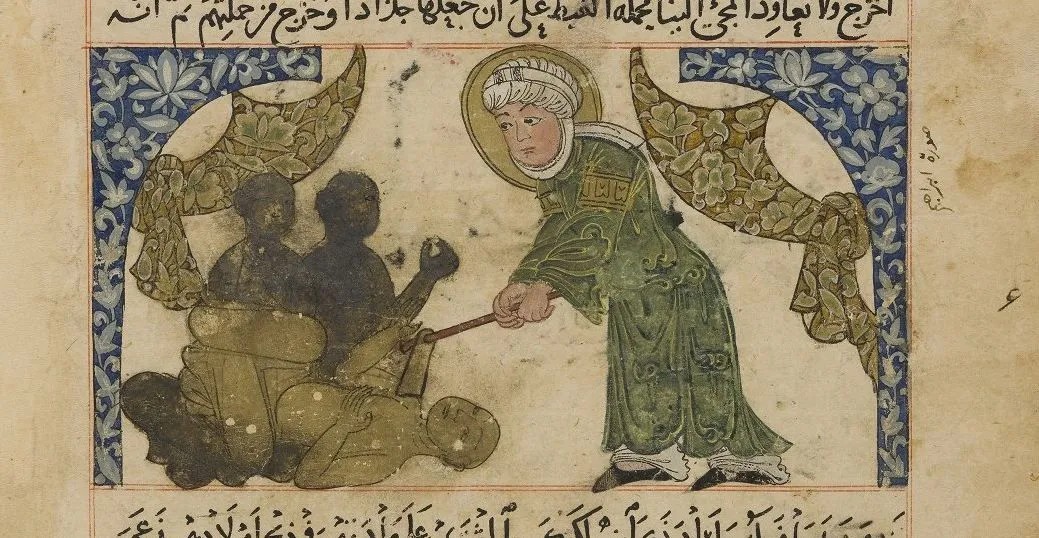
Abraham’s father, Terakh, owned an idol shop. One day, while his father was away and Abraham was left in charge of the store, he took an axe and smashed all the idols except the biggest one. He then placed the axe in the idol’s hands. When his father returned, he was angry and asked what happened. Abraham explained that the large idol had become upset with the other idols and destroyed them.
“You know these idols can’t move,” his father shouted.
Abraham cleverly answered, “If they can’t save themselves, then we are superior to them. So why should we worship them?” [^1]
It is Abraham’s intellectual and spiritual perception — his ability to see through what everyone else around him accepted without question that caught the attention of the Creator of the universe—whom we call HaShem—thereby becoming the father of the Jewish people.
Notes after Torah study- the Patriarch
If you are a believer—whether Christian, Jew, or Muslim—the beginning of our faith starts with Abraham, where the covenant was made. There are layers to this though that are strange.
For reference I'm going to use the acronym “NHI” to represent Non-human intelligence. This could be angels, watchers or beings referred to in the heavenly court reference in Genesis or something else we do not know of.
The story (as taught in Judaism) is this:
Abraham’s father, Terakh, owned an idol shop. One day, while his father was away and Abraham was left in charge of the store, he took an axe and smashed all the idols except the biggest one. He then placed the axe in the idol’s hands. When his father returned, he was angry and asked what happened. Abraham explained that the large idol had become upset with the other idols and destroyed them.
“You know these idols can’t move,” his father shouted.
Abraham cleverly answered, “If they can’t save themselves, then we are superior to them. So why should we worship them?” [^1]
It is Abraham’s intellectual and spiritual perception — his ability to see through what everyone else around him accepted without question that caught the attention of the Creator of the universe—whom we call HaShem—thereby becoming the father of the Jewish people.
However much the faith has splintered over the thousands of years that followed, what can be agreed upon is that Abraham gives us ethical monotheism: the belief that there is one G-d over mankind and earth, and that His primary concern is that people act ethically. The stories of Abraham’s life that follow are epic. G-d tests him in many ways, even to the extreme of commanding him to sacrifice his son Isaac.
Abraham also confronts G-d in one of the most famous lines in history: “Shall not the judge of all the earth act with justice?” [Genesis 18:25]. I do not know what to make of these stories. Beyond the text, they contain mathematical patterns. For example, the ages of the patriarchs: * Abraham — 175 years * Isaac — 180 years * Jacob — 147 years
⠀Look closely at the math: * 175 = 7 × 5² * 180 = 5 × 6² * 147 = 3 × 7²
This is deliberate not coincidence in my opinion. The coefficients decrease (7 → 5 → 3) while the bases increase (5 → 6 → 7). I have no thoughts as to what it means but it certainly hints to encoding something through mathematics that goes beyond the surface story. Archeologically this puts us in the Middle Bronze Age. At that time: * Widespread literacy was rare. * Advanced mathematics (especially the kind of elegant, intentional patterning you’re seeing in the ages) was mostly the domain of specialized scribal or priestly elites in places like Mesopotamia or Egypt. * A semi-nomadic family/clan wandering between Mesopotamia and Canaan would not have been the most likely setting for this kind of numerical sophistication. Source: Grok 7/11/226
Abraham’s stories describe G-d’s role in the world. In the Midrash it says: “So, because Abraham our patriarch was saying: ‘Is it possible that this world is without someone in charge?’ The Holy One, blessed be He, looked at him and said to him: ‘I am the owner of the world.’” — Genesis Rabbah (Sefaria) But I am left with so many questions. If the story of the Patriarchs is true, then we have a population of humans created in the story of Genesis—specifically created by a heavenly council in the image of their maker(s): “And God said, ‘Let us make humankind in our image, after our likeness.’” [Genesis 1:26] Rashi comments on this verse: “The meekness of the Holy One, blessed be He, the Rabbis learned from here: because man is in the likeness of the angels and they might envy him, therefore He took counsel with them. And when He judges the kings, He likewise consults His heavenly council… He consulted His heavenly council and asked permission of them, saying to them: ‘There are in the heavens beings after My likeness; if there will not be on earth also beings after My likeness, there will be envy among the beings that I have created.’” — Rashi on Genesis 1:26 (Rosenbaum & Silbermann translation) The core of this faith is established by how the world came to be and by whom or what. Then Judaism forms with the story of a child smashing idols in a clever and insightful moment—an observation of what society worships. His words are as powerful as his axe.
POSTED BY JON